
Playing Business with Ryan Watson
We who are wise admit we know nothing

Welcome back to The Workaround. I’m Bob 👋
You’re in good company with fellow entrepreneurs and innovators who follow my stories from a career in tech startups and corporate innovation.
I’m here to make you think, smile, and discover a shortcut to success or a trap to avoid.
Listen by hitting the play button above or using your favorite podcast app, or watch us on YouTube.
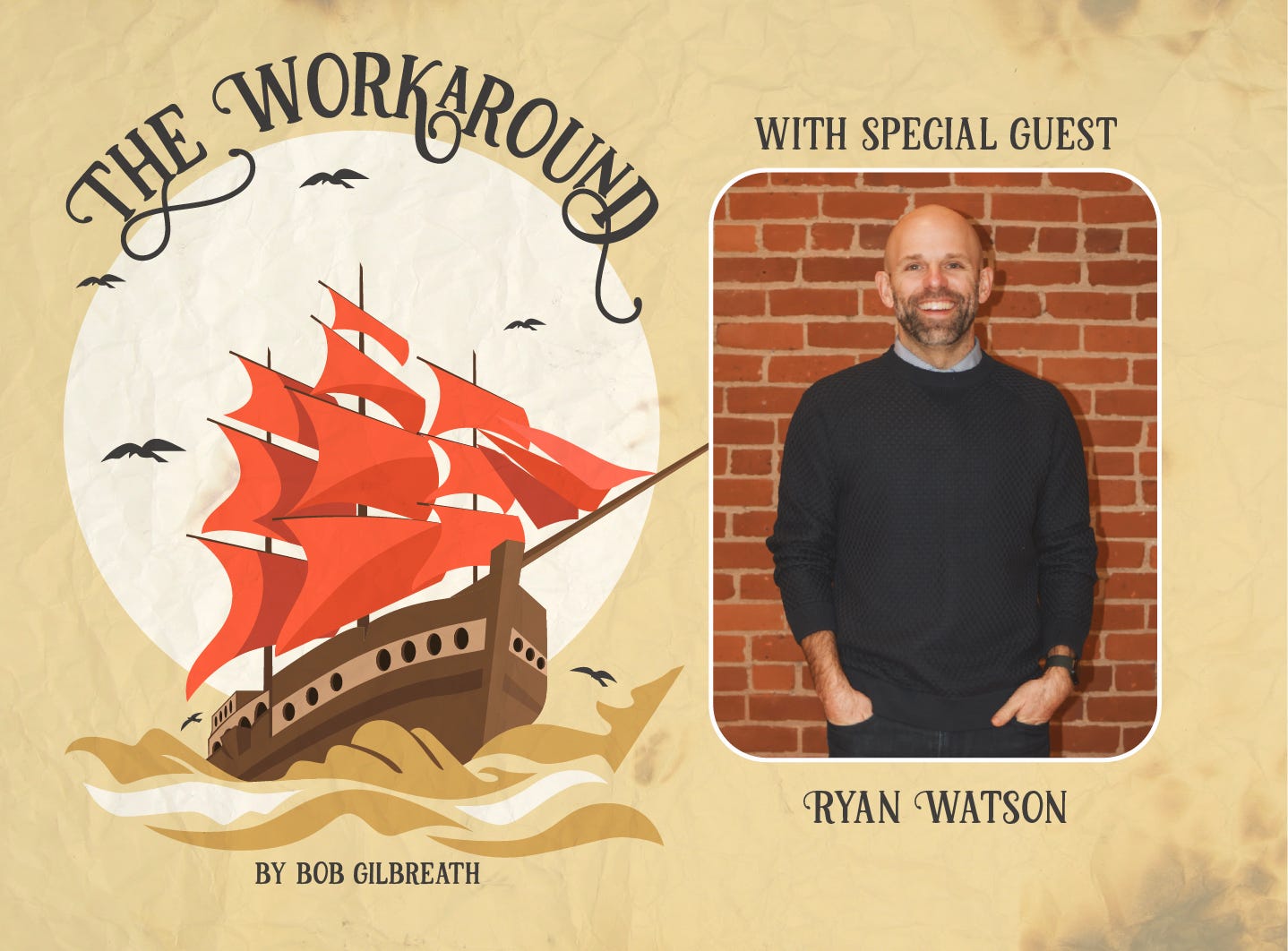
I’m excited to share the next podcast episode in my series of conversations with interesting people on topics where business and life intersect.
Ryan Watson has been my buddy in building startups since 2015. He’s also a partner at Upsourced Accounting, a financial advisory firm for over 100 creative agencies. In between, he’s a husband, father of three, and the most organized youth soccer coach in the Greater Dayton, Ohio region.
Every few months, Ryan and I have a private conversation about what we’ve learned in business that is too good to keep to ourselves. Today’s podcast is one of those times when I remembered to hit the record button.
Our discussion here was sparked by a story a friend told me about her struggles…
Naked and Afraid
My friend, “Gail,” leads client success at a startup that is stuck.
The business was formed to capitalize on a major investment wave a few years ago and has received over $100 million in funding across multiple rounds, with expectations accelerating. The 30-something CEO came from a short career in I-banking after graduating from a top MBA program.
Alas, the company couldn’t achieve IPO dreams before its hype window closed. It has many customers but never planned to be operationally efficient. Now, the Board of investors has told the CEO he must get the company profitable—without further capital support.
And so my friend watches this leader make all the usual flailing mistakes: Like hiring a new sales leader with a fancy resume, who spends a year updating the pitch deck, shuffling territories, and switching CRMs. Or acquiring companies that make no strategic sense and have no integration plan.
She is told to execute layoffs every six months. But the CEO never asks for her input1, despite her two decades of experience in turning around teams.
Why does this CEO struggle so—and not ask for her input? Because he doesn’t know how to run a business. He’s just playing business. It’s the grown-up version of the kind of things most of us did as little kids when we pretended to do what Mom or Dad did for a living.
Key Themes to Listen for
Ryan and I break down what “Playing Business” means—starting with how we made this mistake ourselves, both independently and working together on our startups.
Here are a few teasers from our conversation:
When you don’t know what to do, the sweeping, sexy, silver-bullet decisions seem smart. But they’re not. The real work is getting into the details of how the sausage is made and figuring out how to make a dollar from it.
Be careful doing anything “because everyone else is doing it.” There’s safety in numbers and peer pressure that make us feel we “have to” raise another round, attend that conference in Vegas, or hire a CMO. But there is no playbook! Most new businesses fail, so following others by default is just a way to follow them over a cliff.
Validation ain’t truth. Companies often celebrate “wins” that aren’t about building a real business, such as meaningless awards or appearances on a Top 50 Startups in Cincinnati list. Leading something new is hard, and we need little signs to keep us believing that we’re going to make it. But be careful not to fool yourself, because you are the easiest to fool.
Big company = big playground. You can only play business for so long as an entrepreneur before you get real or hit a wall. But most corporations were around before we joined them and will keep going no matter what decisions we make in our tenure. This can make fertile ground for office politics, empire building, decisions by committee, and general goofing off. Some people find a place that works for them, while others find they must GTFO. Whatever your path, just realize that the people higher in your chain of command are not necessarily smarter than you are.
We also share a bunch of personal stories of learning from our mistakes playing business. And we’ll tell you the most important characteristic to look for when you’re assessing whether the leader of a company you may join is wise enough to know nothing.
Listen by hitting the play button above ^^^ or using your favorite podcast app, or watch us on YouTube.
Helpful links:
If you like my writing, feel free to click the ❤️ or 🔄 button on this post so more people can discover it on Substack 🙏
He can’t even be bothered to learn how to pronounce her name correctly, but that’s another story…
I feel like I've been playing business for a long time. How does a solo entrepreneur with limited time find a way to be good at business while keeping up with delivering their expertise? Business ownership seems a little like parenting to me. The ramifications of doing either one badly impact a lot of people, and one should have to pass some kind of test, or demonstrate some degree of base proficiency before being given keys to the diaper drawer or a business license.
Another great conversation Bob. Thanks for letting us listen in. This is far from original, but I think one contributor to "Playing Business" is being disconnected from the results of the work. If I'm working for a corporation, the impact of playing business today, or many days is minimal. At some point I might get fired for non performance, but I can show up at my assigned workstation and hit metrics and still not do much. And if the person playing office is a level or two above me, I can work as hard as I want, my effort won't succeed because I'm chasing the wrong rabbit.
In my first year as a life insurance agent after leaving corporate land, I realized there was at least 8 weeks between starting a conversation with Bob about insurance and getting paid for the policy he bought. That's a long time between "click' and "bang." I finally started using a calendar I built that showed me projected commission for the next 3-6 months. I needed to see the effect of not producing today, because the impact wasn't immediate, it was delayed.
I wonder if the same principle is at work when the entrepreneur raises a few million in a seed round? They have runway, which blinds them to what happens when that runway ends.
Just a thought.
Your pal down I-75. Josh